
The only King in the Cathedral
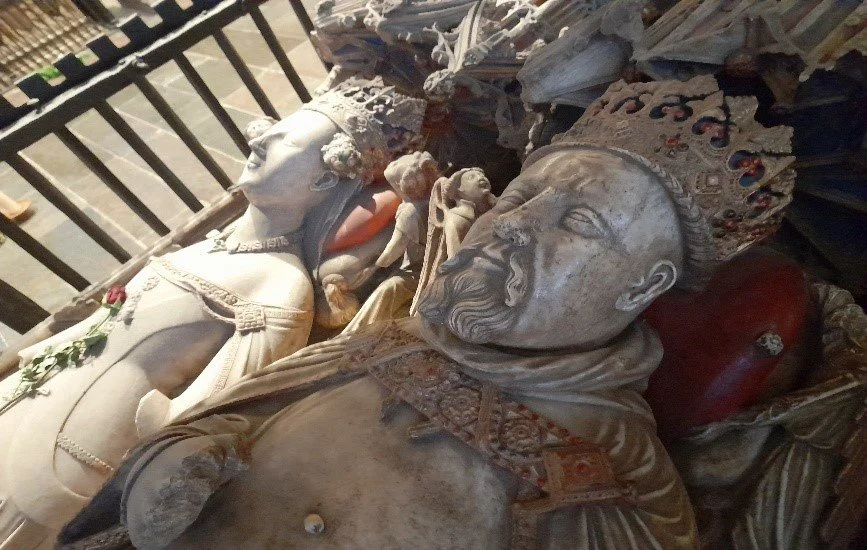
HENRY IV 1399 – 1413. The location of his tomb being the Trinity Chapel, Canterbury Cathedral.
Uneasy lies the head that nicks the crown to misquote Stormzy.
If only Henry had been the rightful king, Henry’s claim to be next in succession after Richard II rested upon being the eldest son of John of Gaunt the fourth son of Edward III. If that is not mind twisting enough, Richard II no children, Edward III has lost his second son in infancy but his third son Lionel who had died had a daughter whose grandson was Edward Mortimer so being descended from the female line. OK, just too complicated.
None of this would have mattered if The Black Prince, Edward Woodstock, had not lived too short and his father Edward III had not lived too long a time. The Black Prince, a national hero, died of dysentery 1376, where as his father Edward III died 1377.
Richard II, son of the Black Prince did rather well in putting down the Peasants’ Revolt 1381 but his ego alienated his Barons. Richard II demanded a crazy level of reverence. Richard believed he was so special, he was the first king to insist on being called your majesty instead of sire, The Wilton Diptych had Mary and baby Jesus deferring to Richard surrounded by angels wearing Richard’s livery. To cap it all Richard had a portrait full face on, a pose reserved for Jesus himself.
Henry IV’s reign began when, with the backing of Parliament in 1399 as Henry Bolingbroke [Richard’s cousin] he landed a small army and took over England unopposed, so unpopular was Richard. Henry imprisoned Richard in Pontefract Castle, where he was starved to death. Henry had the emaciated body displayed St Paul’s Cathedral.
What could possibly go wrong, constant rebellion in Wales, ordering heretics to be burned as approved by Archbishop Canterbury Arundel. Henry IV had leprosy or some kind of severe eczema or psoriasis, and this was taken as a sign of divine displeasure. Henry promised to go on crusade and it was predicted he would die in Jerusalem. Like a cruel joke he did but the Jerusalem Chamber, Westminster Abbey. Henry IV was succeeded by his famous son Henry V.
The tomb in the Cathedral was built by the master mason Richard Beke with Henry recumbent alongside his wife Joan Navarre [surviving him by 24 years]. There is a lion at his feet as only a king may have such an accolade. At the end of the tomb was a painting of Becket for Henry and for Joan a painting of the virgin Mary. Henry asked to be buried near Becket probably in the hope that some of that good becket relic stuff would transfer to him and provide penance for usurping Richard.
The alabaster figures on the tomb are said to be very good likenesses, though a rumour had persisted that the tomb itself did not actually contain the body. It was alleged that the sailors bringing his coffin downriver from London to Canterbury had dumped the king’s body overboard during a storm in the Thames estuary because, so the superstition went, carrying a corpse onboard ship would bring bad luck. In 1832 the tomb was opened revealing the clearly recognizable form of the King matching the effigy on the tomb, his features perfectly preserved, including his red beard until exposed to the inrush of air.