
All around the clocktower
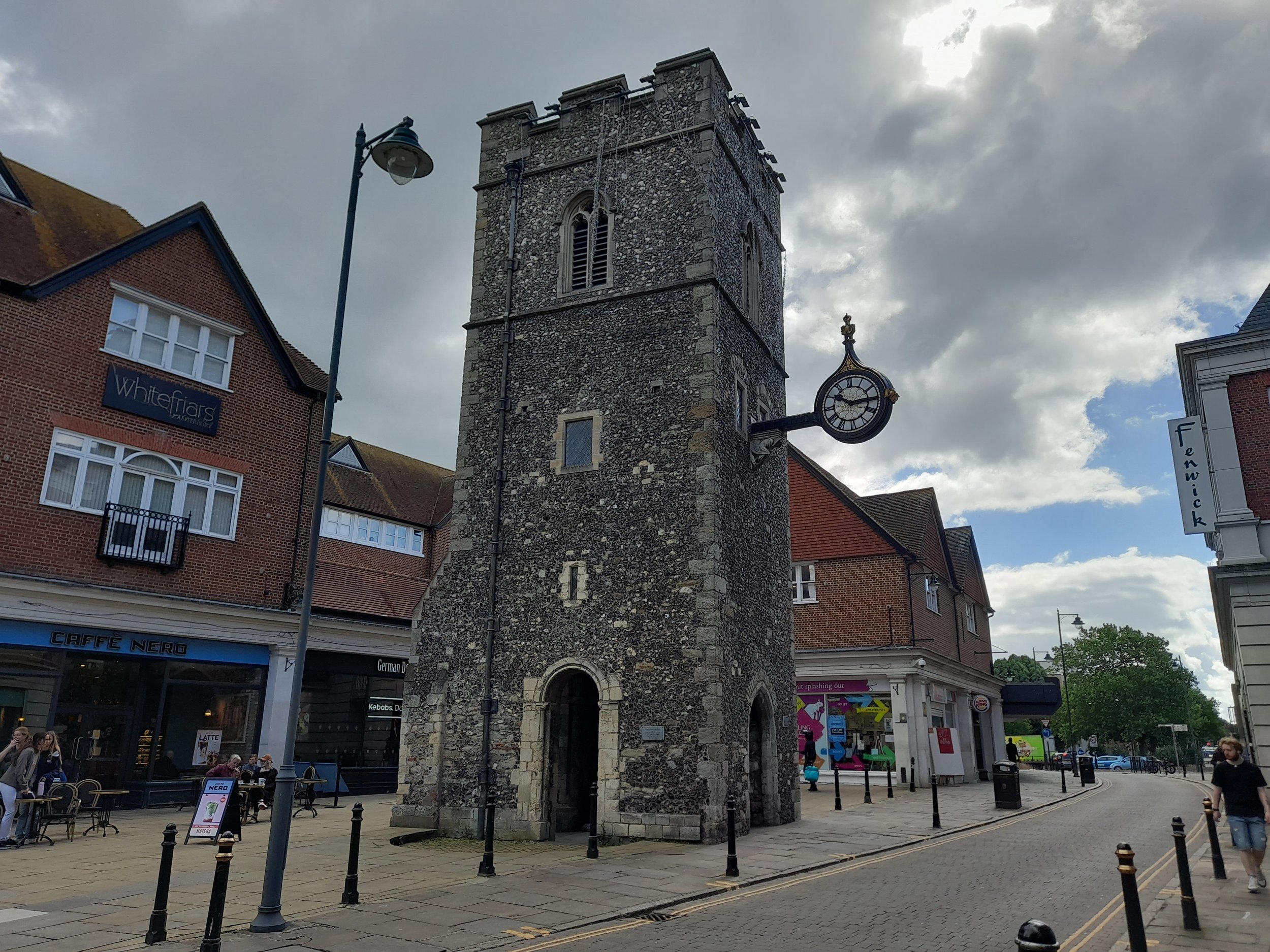
Let us gather all around the clocktower. St George's church tower is a familiar feature to tourists and locals alike but few suspect the layers of history it represents. This striking solitary tower is all that remains of C12th Church of St George the Martyr. It was thanks to the 100 years war that the Georgian St George became the patron saint of England, he was a more in your face aggressive narrative than either St Edward the Confessor or St Edmund King and Martyr.
The Clock dates from 1876 when townsfolk needed to know the time in a way that was compatible with the railroad timetables of Canterbury stations. The point was to know when trains were due to arrive and plan your journey, although to be honest they became a way of knowing that the service was running late.
The Tower dates from around the C15th but has a plethora of architectural features. Much of the structure is built from knapped flint, flint that has been shaped. Where you find chalk, you find flint and flint is much used around town. The tower windows and doors are the semicircular Romanesque/Norman arches with what looks like decorated tracery. There are even the slim red roman tiles to be observed by the oh so twentieth century black drain.
A plaque facing Fenwick commemorates when much of the heart of medieval Canterbury was destroyed in the 1942 Baedeker raid when around 400 buildings lay in ruins, with fire damage to 1500 more yet the clock tower against all odds withstood the assault.
Who was Fritz Baedeker?
Baedeker was not a German military leader but a celebrated travel writer who wrote about splendour of European cities between 1872-1925. Baedeker used a star rating system rating. Hitler used this those cultural cities with a 3-star rating in travel guide as targets to demoralize nation. The 1942 raid on Canterbury was probably a reprisal for the bombing by the Allies of the German cities of Lübeck and Cologne.
The light blue Plaque facing the high street indicates that this was the church that baptised Canterbury's most famous son Christopher Marlowe in 1564
‘Kit’ Marlowe lived a life that was as thrilling as the plays he wrote being a brawler, poet. suspected heretic. possible homosexual and probable Secret agent man for Elizabeth I. Marlowe’s was a boisterous family. Marlowe was the second youngest and had 4 sisters and younger brother. His father John was a cordwainer, not a word common usage today. A cordwainer made quality shoes a name derived from Cordoba in Spain said to provide the finest leather. Cordwainers was one up on cobblers who merely mended shoes. Marlowe’s mother Catherine [daughter of rector St Peters] persuaded her brother Thomas to pay for Christophers fees at the Kings School. The family lived in a house almost opposite the church where Fenwicks is today, located somewhere under the perfume department or White Company departments.
From St George to Kit Marlowe to Fenwicks as I said layers of History, and unless stated the clocktower is where our Walk Canterbury guided tours start stepping